
What Are the Main SEO Practices? (The Core Habits That Actually Move Rankings)
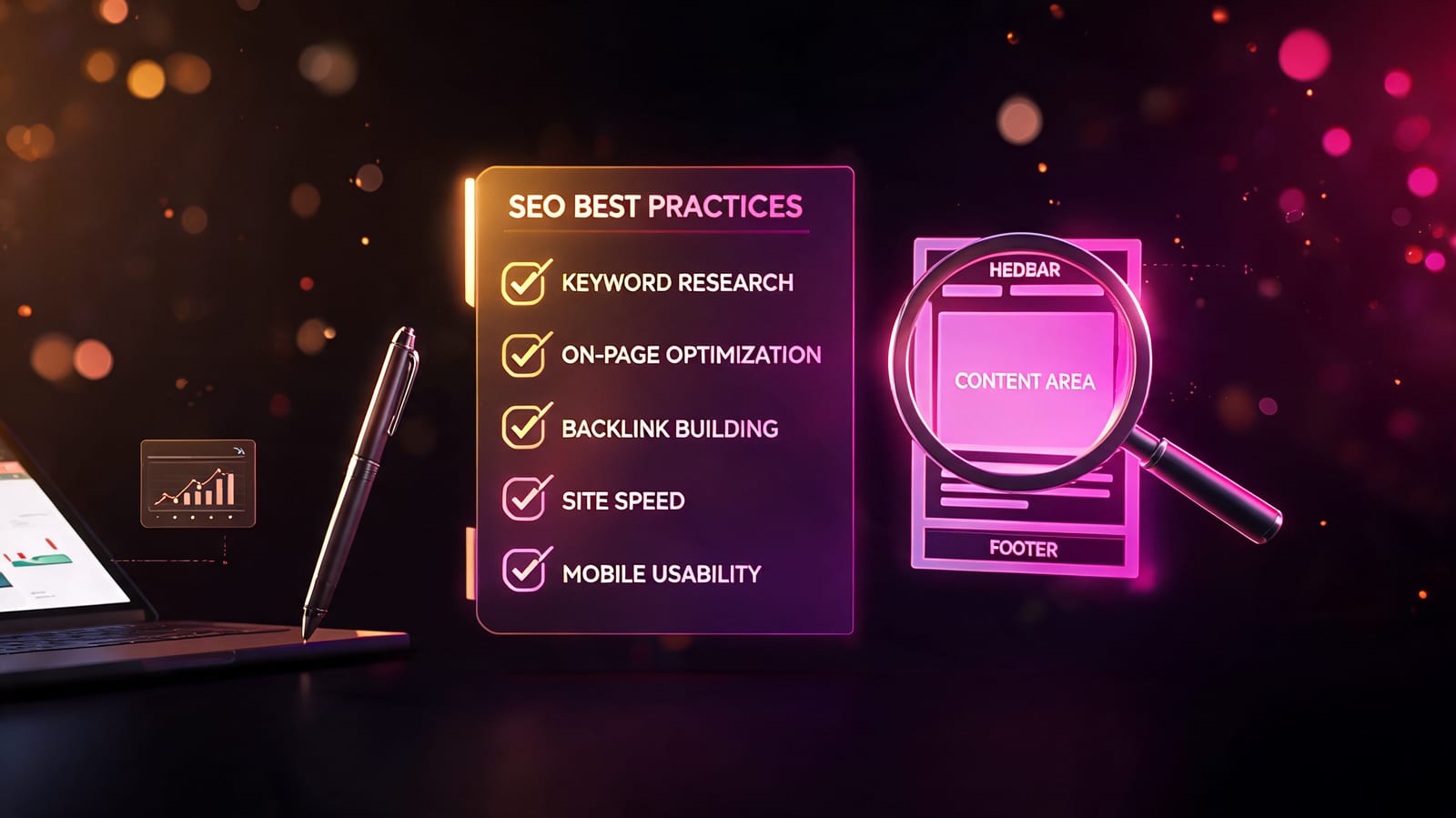
The main SEO practices are: match search intent, get on-page basics right, keep your site technically healthy, publish genuinely useful content, and earn backlinks from trusted sites. Everything else in SEO is a refinement of one of those five. The trap most people fall into is treating them as a flat checklist when they're actually a priority order — some of these set the ceiling on your rankings, and others just decide how close to that ceiling you get.
Here they are in the order that matters, from foundation to differentiator.
1. Match search intent (the practice that comes before all the others)
Before a single optimization, answer one question: what does the person typing this query actually want? Someone searching "best running shoes" wants a comparison, not a shoe you sell. Someone searching "how to clean running shoes" wants steps, not a store page. Rank the wrong kind of page for a query and no amount of on-page tuning saves you.
This is the practice everyone skips because it feels obvious, and it's the one that quietly decides everything. Look at what already ranks for your target query — if the top results are all listicles and yours is a product page, Google is telling you what intent it rewards. Match it or lose.
2. Nail the on-page basics
Once intent is right, make it unmistakably clear to Google what each page is about:
- Title tag — descriptive, includes the phrase people search, reads naturally.
- One clear H1 and a logical heading structure (H2s, H3s).
- Descriptive URL — short, readable, keyword-relevant.
- Meta description — doesn't directly rank you, but earns the click.
- Internal links with sensible anchor text that connect related pages.
- Image alt text and compressed file sizes.
None of this is glamorous, and none of it is optional. On-page is the cheapest, most fully-in-your-control practice on this list — there's no excuse to get it wrong.
3. Keep the site technically healthy
Google can't rank what it can't crawl, render, and index. The technical practices that matter most:
- Speed and Core Web Vitals — fast load, stable layout, quick response.
- Mobile-first — genuinely usable on a phone, where most searches happen.
- Crawlability — clean sitemap, no accidental
noindex, no broken internal links. - HTTPS and a sane site structure.
Technical SEO is a gate, not a lever: fixing it doesn't rocket you up the rankings, but leaving it broken caps everything else at zero. Get it to "not blocking me" and move on — don't over-engineer it.
4. Publish genuinely useful content
This is where you earn the ranking rather than just qualify for it. The practice: be the best answer to the query, not just an answer. That means real depth, first-hand experience or expertise, clear structure, and honesty. Those qualities have a name in Google's own documentation — E-E-A-T — and its systems increasingly reward content that satisfies the searcher while quietly demoting thin, templated pages churned out at scale.
Note that "depth" is not "length." How long a blog post should be for SEO is decided by the query, not by a word-count target, and padding a complete answer makes it worse.
Useful content is also what makes every other practice pay off — it's what people link to, cite, and share. You can't shortcut it, and in 2026 the attempts to (mass AI-spun pages) are exactly what Google is hunting down. Depth compounds; thinness gets penalized.
5. Earn backlinks from trusted sites
The final practice is the one that separates sites that should rank from sites that do: other credible sites vouching for you. Backlinks remain one of Google's strongest signals because they're hard to fake — they require someone else to decide your page is worth pointing to.
This is deliberately last, because it's the practice with the highest leverage and the highest difficulty. The first four you can execute entirely at your desk. This one requires other people to say yes, which is slow and has a brutal rejection rate — which is precisely why it stays such a durable ranking signal. For a full playbook, see how to create backlinks.
The order is the whole point
Miss the priority order and you waste months. The classic mistake is obsessing over practice #2 (endlessly tweaking title tags) while ignoring #1 (wrong intent entirely) and #5 (no authority). A rough diagnostic:
- Not indexed? → Technical. Fix first; nothing else matters.
- Indexed, thin content? → Content depth.
- Good content, wrong page type ranking? → Search intent.
- Great content ranking lower than it should? → On-page clarity or, more often, missing authority.
- Everything's dialed in but you're stuck behind bigger sites? → Almost always backlinks.
That last wall is where most capable site owners stall. You've done the homework; the tiebreaker is authority, and it's the one practice you can't complete alone.
The practice you can't do at your desk
Four of the five main SEO practices are solo work — intent, on-page, technical, and content are all things you control directly. The fifth isn't, by definition. That asymmetry is why so many sites do everything "right" and still don't rank: they've mastered the four they control and stalled on the one they can't.
Backlinkster is built for that fifth practice specifically. It matches you with real site owners in related niches to trade one-for-one in-content links, each verified live and dofollow by code — so a newer site can earn genuine authority without buying links or waiting years. It won't write your content or fix your technical setup; it addresses the single practice that requires someone else to participate.
The bottom line
The main SEO practices are matching search intent, on-page basics, technical health, useful content, and earned backlinks — in that order of priority. Treat them as a sequence, not a checklist: the early ones gate whether you rank at all, and the last one decides whether you beat the sites that also did everything right. Most people over-invest in the middle and neglect the ends. Fix intent first, authority last, and you'll outrun sites twice your size.
Related: Are backlinks good for SEO? · What is a 90-day SEO plan? · What is anchor text? · What is E-E-A-T in SEO? · How long should a blog post be for SEO?