
What Are the 5 Important Concepts of SEO? (A Clear Breakdown)
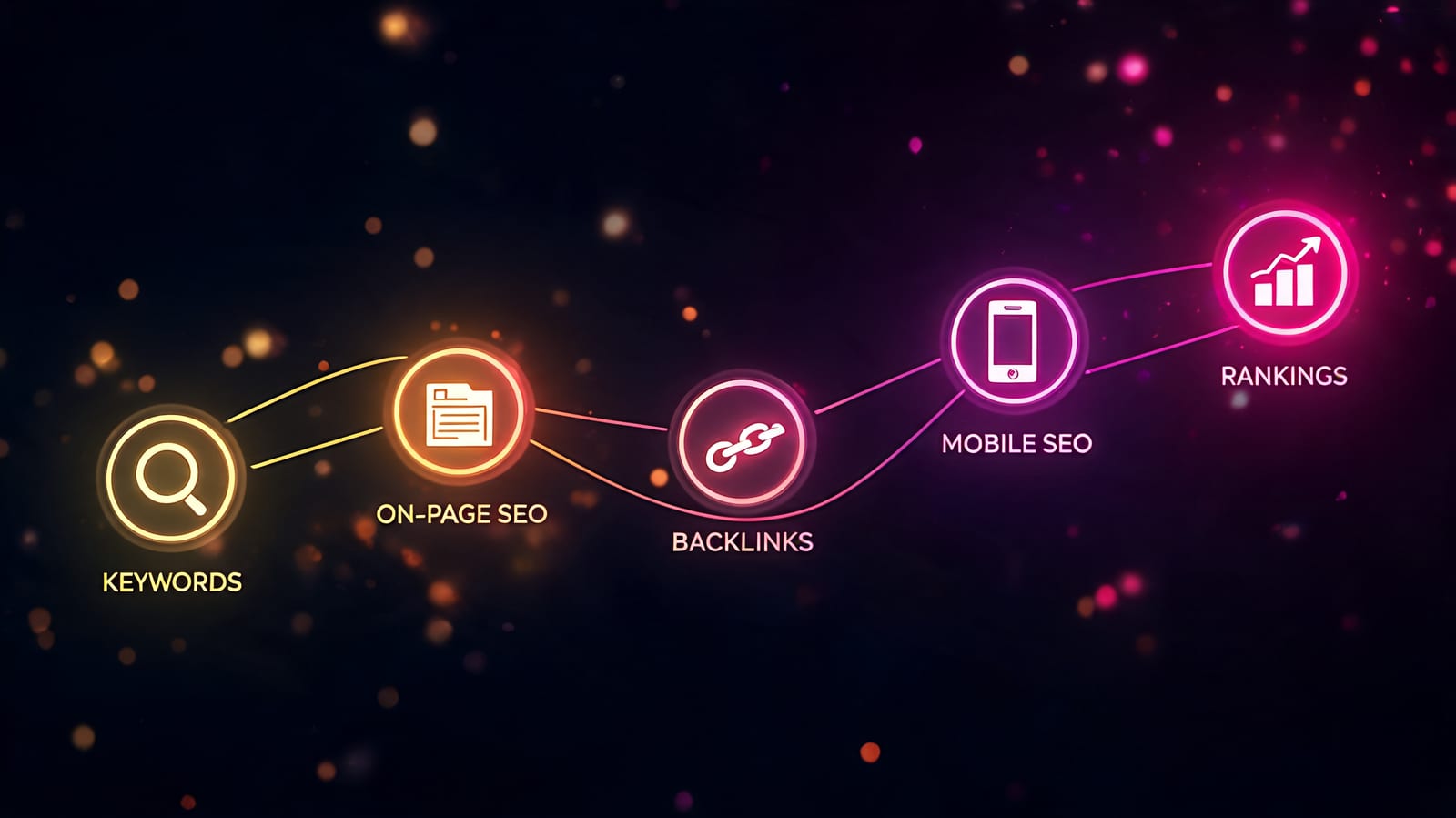
The five most important concepts of SEO are relevance, authority, crawlability, user experience, and search intent. Nearly every SEO tactic — from keyword research to backlinks to site speed — is really just a way of improving one of these five. Understand them and you stop memorizing tips and start seeing why things work.
1. Relevance — does your page match the query?
Relevance is how well your page answers what the searcher actually typed. Google's first job is to return pages about the query, so relevance is the entry ticket — no amount of authority saves a page that doesn't address the search.
You build relevance by:
- Targeting a clear primary topic per page.
- Covering the subtopics real searchers expect (the "people also ask" questions).
- Using the target keyword and its natural variations in your content, headings, and title.
Relevance also applies to backlinks: a link from a site in your niche is a relevance signal, which is why relevant links outperform random high-authority ones.
2. Authority — can your page be trusted?
Authority is the credibility of your page and domain in the eyes of search engines. When two pages are equally relevant, the more authoritative one wins — and authority is built largely through backlinks. Each link from a trusted, relevant site is a vote that raises your standing.
This is the concept behind domain authority: sites with strong, trusted link profiles rank more easily, and they pass some of that trust through their links. Authority is the slowest of the five concepts to build and the hardest to fake, which is exactly why backlinks remain central to SEO.
3. Crawlability — can Google actually read your site?
Crawlability (and indexing) is the technical concept: search engines must be able to find, render, and store your pages before any of the other four concepts matter. A perfect page that Google can't crawl simply doesn't exist in search.
The essentials:
- No crawl blocks — clean robots.txt, no accidental
noindex. - A working sitemap so Google finds all your pages.
- Fast load and Core Web Vitals — slow pages get crawled and ranked less.
- Mobile-first rendering — Google indexes the mobile version.
Crawlability is usually a fix-once-then-maintain concept, which makes it high-leverage: solve it and every page benefits.
4. User experience — do people get what they came for?
Search engines increasingly judge pages by how well they satisfy users, not just how they're optimized. If people click your result and immediately bounce back to Google, that's a signal your page didn't deliver. User experience ties several things together:
- Readability — clear structure, short paragraphs, scannable headings.
- Speed and stability — no long loads or content jumping around.
- Intentful design — the answer is easy to find, not buried under fluff.
- Trust signals — a page that looks credible keeps people on it.
Good UX makes every other concept work harder: relevant, authoritative content still needs to actually satisfy the person who lands on it.
5. Search intent — why did they search?
Intent is the concept that ties the other four together: what the searcher is really trying to accomplish. The same keyword can carry different intents, and matching the wrong one means ranking is nearly impossible.
The main intent types:
- Informational — "how do backlinks work" (they want to learn).
- Navigational — "backlinkster login" (they want a specific site).
- Commercial — "best link building tool" (they're comparing before buying).
- Transactional — "buy backlink software" (they're ready to act).
Nail the intent and a modest page can outrank a stronger one that misreads what the searcher wanted. Always ask "what does this person actually want?" before writing a word.
How do these five concepts fit together?
Think of them as a chain, each link required:
- Crawlability gets your page into the index.
- Relevance makes it eligible for the query.
- Intent ensures it's the right kind of answer.
- Authority wins the tiebreaker against competitors.
- User experience keeps you there by satisfying real people.
A weakness in any one caps the others. A wonderfully authoritative page that misreads intent won't rank; a perfectly relevant one that can't be crawled won't either. Strong SEO isn't about maxing one concept — it's about having no glaring gap across all five. For the strategic pillar view, see the 4 pillars of SEO.
Where most sites are weakest
For the majority of sites, the bottleneck is authority — because it depends on other sites linking to you, and that's the hardest signal to build on your own. Content and technical fixes are within your control; earning trust from the rest of the web isn't.
That's the gap Backlinkster closes: it matches you with real site owners in related niches to trade verified, in-content backlinks one-for-one — a practical way to build the authority concept while you handle relevance, crawlability, UX, and intent yourself.
Master these five concepts and SEO stops feeling like a bag of tricks. Every tactic you'll ever read about is just one of these five, wearing a different name.
Related: The 4 pillars of SEO · What is domain authority?