
What Are the Four Types of SEO? (And How They Fit Together)
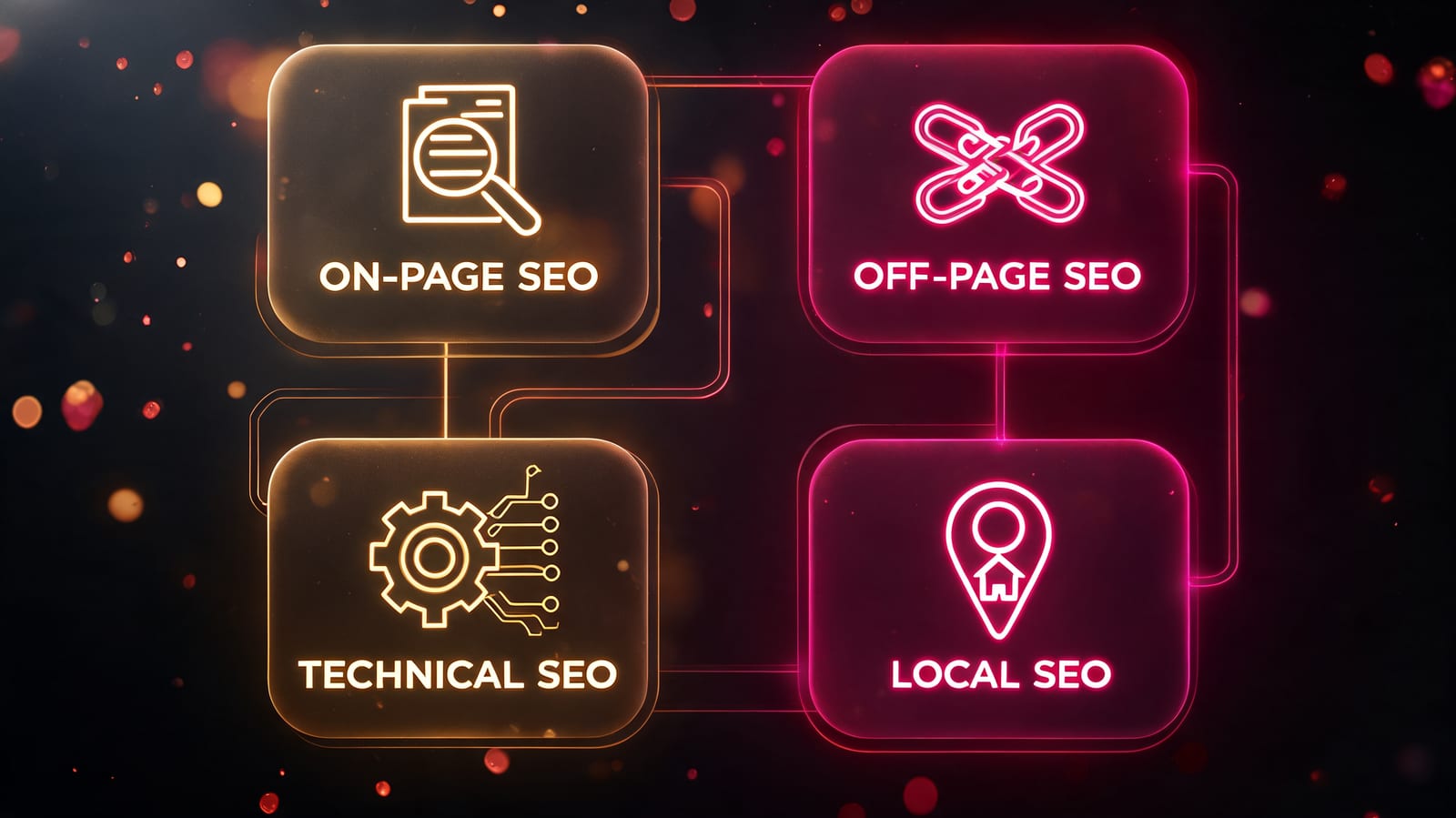
The four types of SEO are on-page SEO, off-page SEO, technical SEO, and local SEO. On-page is about your content and how each page is optimized; off-page is about your reputation across the web (mostly backlinks); technical is about how well search engines can crawl and render your site; local is about ranking in a specific geographic area. Strong SEO needs all four working together — a gap in any one caps the results of the others.
1. What is on-page SEO?
On-page SEO is everything you control on the page itself to help it rank and satisfy searchers. It's the foundation, because no amount of links will rank a page that doesn't answer the query well.
It includes:
- Content quality and relevance — genuinely answering the search intent, in depth.
- Title tags and meta descriptions — the clickable headline and summary in search results.
- Headings and structure — clear
H1/H2hierarchy that maps to what people ask. - Internal linking — connecting related pages so both users and Google understand your site.
- Keyword usage — using the target phrase and its variations naturally, not stuffed.
If you're just starting, on-page is where you get the fastest, most durable wins.
2. What is off-page SEO?
Off-page SEO is everything that happens off your site that builds its authority and reputation — and it's dominated by backlinks. When other sites link to you, Google treats it as a vote of confidence. The more relevant and authoritative those votes, the more your pages can rank.
Off-page work includes:
- Earning and building backlinks from relevant sites.
- Digital PR and unlinked-mention reclamation.
- Brand mentions and reputation across the web.
Off-page is usually the hardest of the four because it depends on other people. It's also the biggest differentiator on competitive keywords — when two pages are equally well-optimized on-page, the stronger backlink profile wins.
3. What is technical SEO?
Technical SEO makes sure search engines can actually crawl, render, index, and trust your site. It's the plumbing — invisible when it works, catastrophic when it doesn't. A brilliant page that Google can't crawl or that takes eight seconds to load won't rank no matter how good the content is.
Core technical factors:
- Crawlability and indexing — robots.txt, sitemaps, no accidental
noindextags. - Site speed and Core Web Vitals — how fast and stable the page feels to load.
- Mobile-friendliness — Google indexes the mobile version first.
- HTTPS and security — a baseline trust requirement.
- Structured data — schema markup that helps Google understand your content.
Technical SEO is often a fix-it-once-then-maintain discipline, which makes it high-leverage: solve the big issues and every page benefits.
4. What is local SEO?
Local SEO helps you rank for searches tied to a place — "plumber near me", "coffee shop in Austin". If you serve a geographic area, this is where a lot of your traffic decision happens.
Local SEO focuses on:
- Google Business Profile — your listing, categories, hours, and photos.
- NAP consistency — the same Name, Address, Phone everywhere online.
- Local citations and directories — listings in relevant local and industry directories.
- Reviews — volume, recency, and rating on Google and elsewhere.
- Localized content — pages that speak to the areas you serve.
If you're a purely online business, local SEO matters less — but for anyone with a physical location or service area, it can be the highest-ROI type of all.
How many types of SEO are there, really?
Four is the standard, most useful breakdown — but you'll see other groupings depending on who's teaching. Some split out content SEO from on-page, or add mobile SEO and international SEO as their own categories, or separate e-commerce SEO for online stores. These aren't contradictions; they're zoom levels. The four-type model (on-page, off-page, technical, local) covers the whole picture — the extra labels are just sub-specialties inside it.
Which type of SEO should you focus on first?
Sequence them by leverage:
- Technical first — fix anything blocking crawling or killing speed. No point optimizing pages Google can't read.
- On-page next — make each target page genuinely the best answer to its query.
- Off-page ongoing — start building relevant backlinks steadily and never really stop.
- Local in parallel — if you serve an area, run local SEO alongside the rest from day one.
The mistake most people make is treating these as separate projects. They're not — they're four levers on the same machine. A technically clean, well-written page still needs links to compete, and the best links in the world can't save a page Google can't crawl.
Off-page tends to be the bottleneck because it depends on other sites. That's the gap Backlinkster is built to close: it matches you with real site owners in related niches to trade verified, in-content backlinks — a practical way to keep the off-page pillar moving while you handle the other three. Pair it with the 4 pillars of SEO for the strategic view.
Related: What is local SEO and who needs it? · The 4 pillars of SEO · Are backlinks good for SEO?